
eSIM vs. Classic SIM Card: Which to choose in 2026? (Complete Comparison)
eSIM or classic SIM card: which is the best option in 2026? A complete comparison based on 8 criteria, advantages and disadvantages of each solution, and for whom the eSIM is truly a game-changer.
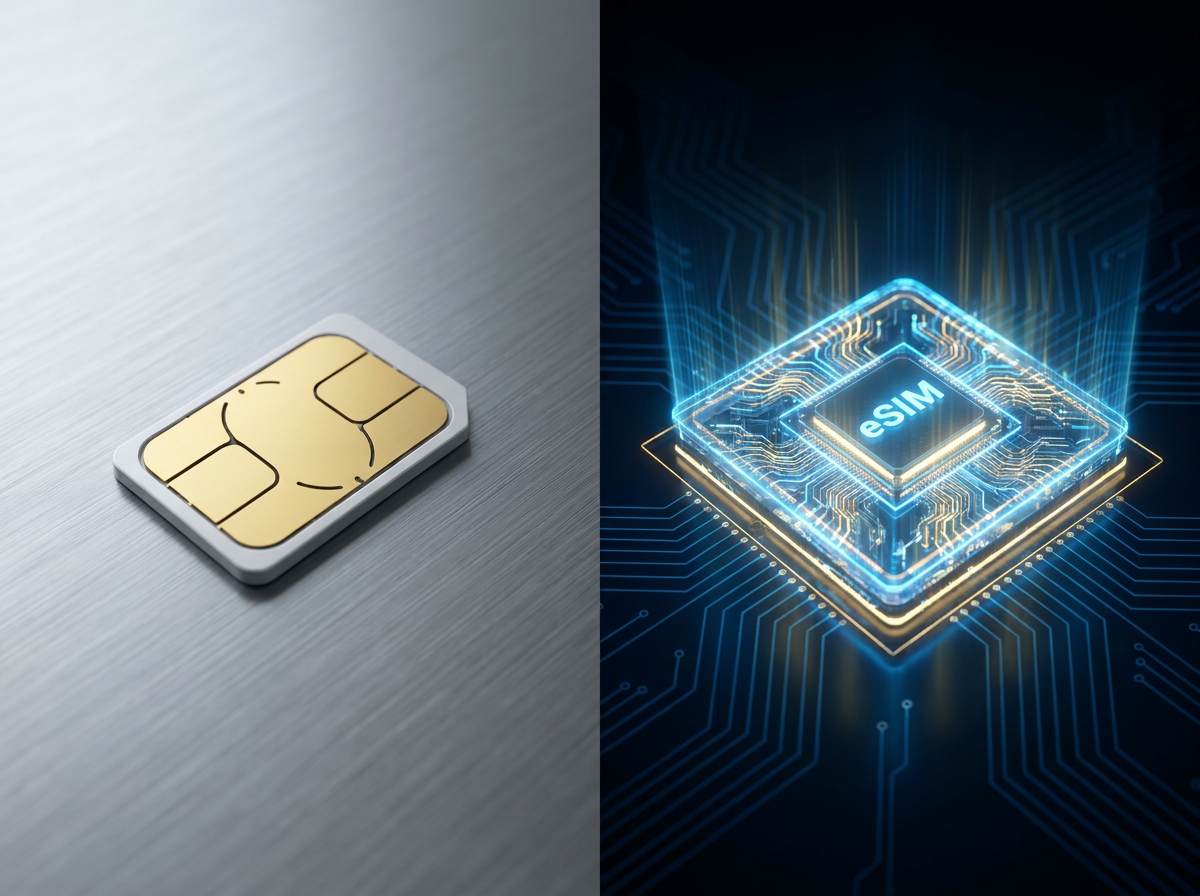
For decades, the physical SIM card was the only way to connect a phone to a mobile network. You received a small plastic rectangle from your operator, inserted it into your phone, and that was it. Simple, familiar, and nobody really questioned the system.
Then the eSIM appeared. And since then, the question regularly arises: is the eSIM really better than a classic SIM? For whom? In what situations? And what does it concretely change for Belgian travelers?
This guide answers all these questions with an honest comparison based on eight essential criteria.
Understanding both technologies
The physical SIM card: what you know
The classic SIM (Subscriber Identity Module) is a physical medium — a chip on a small piece of plastic — that stores your subscription information: your subscriber ID, your operator's data, and network connection settings.
There are three formats: Standard SIM (large, increasingly rare), Micro SIM, and Nano SIM (the most common today). To change operators or use a foreign plan, you must physically remove one card and insert a new one.
What doesn't change with a physical SIM:
- It is linked to a specific operator (unless unlocked)
- It can be lost, damaged, or stolen
- It occupies a physical slot in your phone
- Changing plans or operators requires a new card
The eSIM: the integrated and reprogrammable SIM card
The eSIM (Embedded SIM, technically eUICC — embedded Universal Integrated Circuit Card) is a chip soldered directly onto your smartphone's motherboard. It cannot be removed.
Several operator profiles can be stored on this chip — each corresponding to a different subscription. To activate a new plan, you download a digital profile via a QR code or an application. No physical manipulation, no need to visit a store.
A single smartphone can thus simultaneously contain:
- Your main Belgian subscription (profile 1)
- An Arivia travel eSIM for your destination (profile 2)
- Other stored but inactive profiles
Comparison based on 8 criteria
Criterion 1: Ease of daily use
Physical SIM: Very simple once in place. But changing cards requires finding the ejection tool, opening the tray, and manipulating a tiny component. Risk of loss or mishandling.
eSIM: Entirely digital management. Changing profiles takes only a few seconds in your phone settings. No tools, no physical manipulation.
Advantage: eSIM ✓
Criterion 2: Activating a travel plan
Physical SIM: To use a local plan abroad, you must either buy a local SIM once you arrive (find a point of sale, wait in line, potential language barrier), or use your Belgian operator's roaming (expensive outside the EU).
eSIM: You purchase your plan online before departure from Arivia, install the profile from your couch in ten minutes, and arrive already connected at your destination airport.
Advantage: eSIM ✓ (considerable time saving)
Criterion 3: Dual SIM — using two lines simultaneously
Physical SIM: On a dual-slot phone, you can have two active physical SIMs simultaneously. But this type of device is less common and uses two slots for two distinct cards.
eSIM + Physical SIM: The most common and practical configuration. Your physical Belgian SIM remains active for calls and texts on your usual number; your eSIM handles mobile data abroad. Both work at the same time.
Advantage: eSIM ✓ (native dual SIM on almost all modern smartphones)
Criterion 4: Security
Physical SIM: Can be physically stolen or removed from your phone by a third party. If your phone is stolen, someone can extract your SIM and use it in another device.
eSIM: Integrated into the motherboard — impossible to remove physically. eSIM profiles are linked to the device's IMEI and cannot be transferred without authorization. If stolen, your profile cannot be used on another phone.
Advantage: eSIM ✓
Criterion 5: Device compatibility
Physical SIM: Compatible with virtually all phones, including older and more affordable ones. No technological restrictions.
eSIM: Requires a compatible device. iPhones from XS (2018), Samsung Galaxy S from S20 (2020), Google Pixel from 3 (2018) are compatible. Low-end smartphones and older devices are often not.
Advantage: Physical SIM ✓ (universal compatibility)
Criterion 6: Multi-destination management
Physical SIM: For each country outside the EU, you will either incur roaming charges or have to buy a new local SIM. Each destination = a new process.
eSIM: Some eSIM plans cover multiple countries or entire regions (Europe, Asia, Middle East). You install a single profile and are covered in several destinations. Ideal for variable itinerary trips.
Advantage: eSIM ✓
Criterion 7: Resilience in case of problems
Physical SIM: If you lose your SIM or it is damaged, you have to go to a store to get a new one. Abroad, this can take time.
eSIM: If your phone is lost or broken, the eSIM profile is linked to the device. On a new device, you must contact your provider (Arivia) to get a new profile. The procedure is digital — no physical travel required.
Advantage: Tie — each scenario has its nuances
Criterion 8: Cost for travel outside the EU
Physical SIM (Belgian roaming): €8 to €15 per day with a daily plan. €56 to €105 for a week outside the EU.
Local SIM card: €5 to €20 for a week depending on the country — very competitive, but your Belgian number is inactive.
eSIM: €10 to €25 for a week depending on the destination — comparable in price to a local SIM, with the advantage of keeping your Belgian number via dual SIM.
Advantage: eSIM and local SIM are equal on price, but eSIM ✓ in terms of convenience and maintaining the Belgian number
Summary table
| Criterion | Physical SIM | eSIM |
|---|---|---|
| Ease of changing | Requires manipulation | Digital, in a few seconds |
| Travel plan activation | Purchase on site | Installation at home before departure |
| Dual SIM | Depends on phone model | Native on all modern devices |
| Security | Can be physically stolen | Linked to IMEI, non-extractable |
| Device compatibility | Universal | From 2018-2020 depending on brand |
| Multi-destinations | Different SIM per country | Single multi-country profile possible |
| Belgian number while traveling | Inactive if local SIM | Active (dual SIM with physical SIM) |
| Cost outside EU (week) | €56–105 (roaming) | €10–25 |
For whom is the eSIM the best option?
The frequent traveler
You go 3 to 5 times a year to various destinations. The eSIM saves you from looking for a local SIM upon each arrival. You buy your plan from your couch the day before departure and are connected as soon as you land.
The traveler who wants to stay reachable
You don't want your family and colleagues to lose your Belgian number during your vacation. The eSIM + dual SIM is the only solution that combines an affordable data plan AND the continuity of your usual number.
The multi-destination traveler
You are traveling for a month through Southeast Asia or several African countries. Some eSIM plans cover multiple countries in the same region — a single profile for the entire itinerary.
The business traveler
Online meetings, intensive emails, access to cloud documents: you need a reliable and predictable connection. The eSIM offers exactly that, at a fixed price known before departure.
For whom does the physical SIM remain the best option?
The user of an old or entry-level phone
If your device doesn't support eSIM, the physical SIM remains your only option. Check your phone's compatibility in its settings.
The long-term traveler in a single country
If you are going for 2 to 3 months in the same country and price is your absolute priority, a local prepaid SIM remains the cheapest option. The downside: your Belgian number is inactive.
The traveler who prefers to handle everything on-site
Some travelers appreciate the physical step of buying a local SIM at the airport — human contact, personalized advice from the local operator. If you travel regularly to the same country and know the good points of sale, this is a valid approach.
The future belongs to eSIM
Apple has started removing the physical SIM port in some markets — iPhone 14 and 15 sold in the United States are entirely eSIM-only. The trend is clear: smartphone manufacturers are gradually reducing or eliminating physical SIM slots to save space and improve device waterproofing.
In Europe, the physical SIM port is maintained for now due to regulatory requirements. But in the medium term, eSIM will be the default standard for all high-end smartphones.
Familiarizing yourself with eSIM now means anticipating an inevitable change — while benefiting from immediate savings on every trip outside the EU.
Frequently Asked Questions
Can an eSIM and a physical SIM be used at the same time? Yes. That's the principle of dual SIM. The physical Belgian SIM manages your calls and texts; the eSIM manages your mobile data. Both work simultaneously.
Does eSIM completely replace the physical SIM? No — not yet in Belgium and Europe. The eSIM is in addition to your existing physical SIM. Your Belgian number remains on your physical SIM.
Can I have multiple eSIMs on one phone? Yes. Recent iPhones can store up to 8 eSIM profiles. You can activate or deactivate each profile depending on your destination.
Is eSIM more expensive than a local physical SIM? Not significantly. The price of an Arivia eSIM is comparable to that of a local prepaid SIM in most destinations — with the advantage that you install it from home and your Belgian number remains active.
What happens if I factory reset my phone? eSIM profiles are deleted. Keep your original QR code in a safe place to reinstall the profile if necessary.
Conclusion: eSIM dominates for travelers in 2026
Out of 8 comparison criteria, the eSIM wins 6 of the 8 rounds. It is more practical, more secure, more flexible, and more economical for travel outside Europe.
The physical SIM retains an advantage in universal compatibility — all phones accept it. But if your smartphone was released after 2019 and you regularly travel outside the EU, switching to eSIM for your trips is the obvious choice.
Try Arivia eSIM for your next trip and discover the difference for yourself.